A good camping toilet should be stable, easy to clean, simple to transport, and compatible with the waste-disposal rules at your destination. For most car campers and families, a self-contained flushable toilet such as the Thetford Porta Potti 565E provides the most home-like experience. For remote campsites where human waste must be packed out, the folding Cleanwaste GO Anywhere Portable Toilet is a stronger choice because it works with sealed waste-bag systems.
Budget campers can keep things simple with a Reliance Luggable Loo, while travelers with limited vehicle space may prefer the folding Reliance Fold-to-Go. Campers wanting a waterless system can consider a urine-diverting dry toilet such as the BOXIO Toilet XL.
The right choice depends less on luxury features and more on where you camp, how many people will use it, how you will transport waste, and where that waste can legally be emptied.
Best Camping Toilets at a Glance
| Camping toilet | Best for | Toilet type | Main advantage | Main limitation |
|---|---|---|---|---|
| Thetford Porta Potti 565E | Best overall | Flushable holding-tank toilet | Comfortable, home-like design | Bulky when tanks are full |
| Cleanwaste GO Anywhere | Remote campsites | Folding bag-system toilet | Pack-out friendly and highly portable | Requires replacement waste kits |
| Reliance Luggable Loo | Best budget | Bucket toilet | Cheap, simple, lightweight | Basic comfort |
| Reliance Fold-to-Go | Small cars and storage | Folding bag toilet | Packs flatter than a bucket | Lower seat height |
| BOXIO Toilet XL | Waterless camping | Urine-diverting dry toilet | No flush water or chemical tank | More involved waste management |
How We Selected These Camping Toilets
This is a research-based buying guide. Xplore Terrainz has not represented these products as personally field-tested unless explicitly stated.
We compared current manufacturer specifications and considered:
- Toilet type
- Seat comfort
- Stability
- Packed dimensions
- Empty weight
- Waste capacity
- Water requirements
- Cleanup
- Waste-disposal method
- Suitability for children and families
- Suitability for car camping
- Remote-camping practicality
- Replacement-bag or chemical requirements
- Storage inside a vehicle
Waste rules deserve extra weight in this category. A toilet can be mechanically excellent but still be unsuitable for a trip if its disposal method conflicts with the land-management rules at your destination.
The Bureau of Land Management notes that some environments allow properly buried human waste, while desert, alpine, canyon, and other sensitive areas may require visitors to pack it out. Some individual sites impose even stricter requirements.
1. Thetford Porta Potti 565E
Best Overall Camping Toilet
Best for: Car camping, families, RV-style camps, longer stays
Type: Flushable portable toilet
Waste tank: 5.5 gallons
Fresh-water tank: 4 gallons
Seat height: 17.44 inches
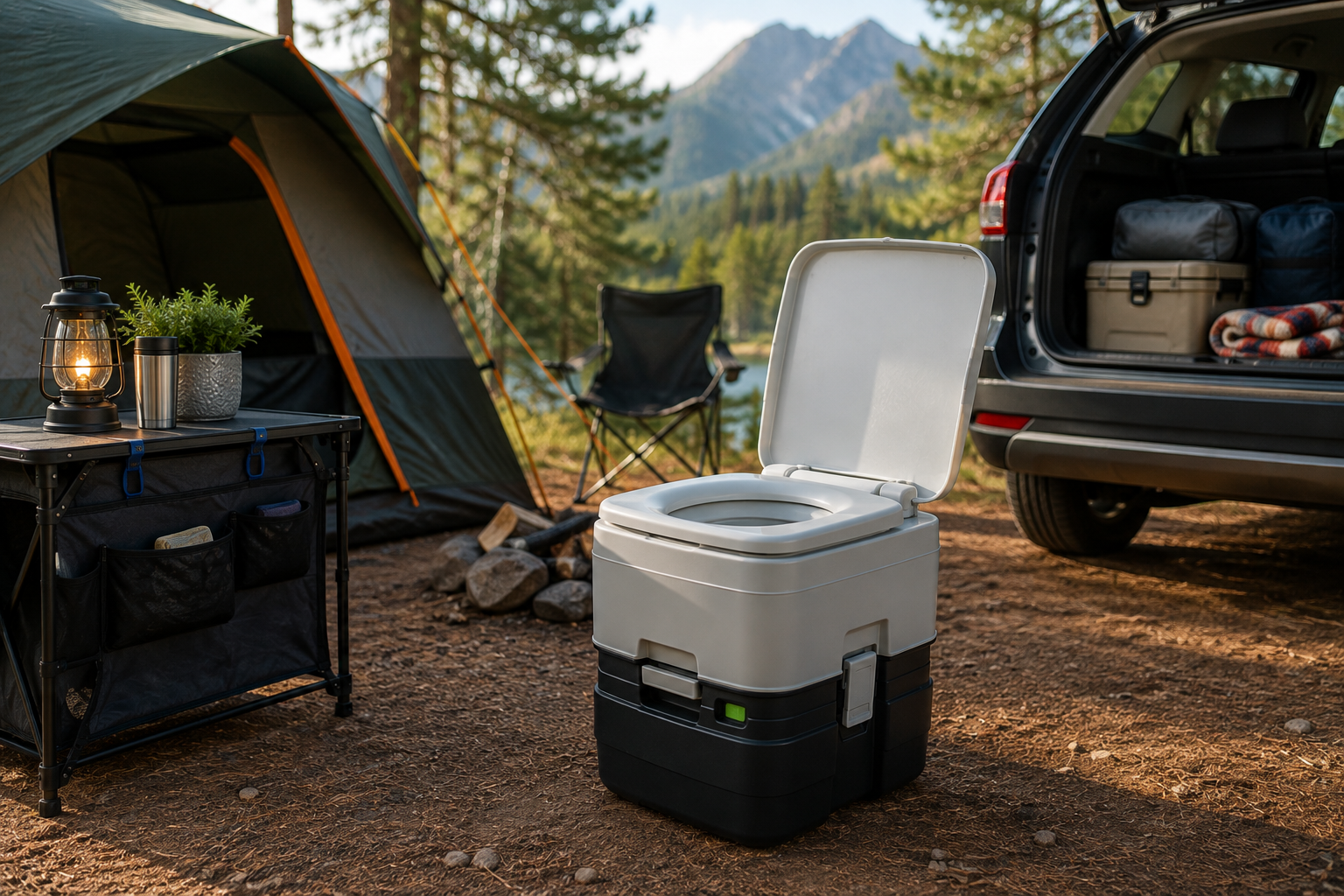
The Thetford Porta Potti 565E is our strongest overall choice for campers who want something that feels closer to a household toilet.
It uses a battery-powered electric flush, has separate fresh- and waste-water tanks, level indicators for both tanks, a carrying handle, an integrated toilet-paper holder, and a seat height of approximately 17.44 inches. The waste tank holds 5.5 gallons, and the fresh water tank holds 4 gallons.
That higher seat and enclosed tank system make it particularly useful for families, older campers, and anyone who dislikes squatting over a bucket-style toilet.
Why it stands out
- Familiar toilet-style seat
- Electric flush
- Separate fresh-water and waste tanks
- Waste-level indicator
- Fresh-water indicator
- Integrated toilet-paper storage
- No disposable bag required for every use
- Better suited to several users than very small systems
Where it works best
The Porta Potti makes the most sense at:
- Developed campgrounds without a convenient restroom
- Family camps
- Multi-night car camping trips
- Base camps
- Vans with enough storage space
- Emergency home or vehicle setups
Main drawbacks
The toilet becomes substantially heavier as its tanks fill. It also requires a legal location where the holding tank can be emptied.
Do not assume that a vault toilet, a campground pit toilet, or an ordinary trash receptacle is an acceptable dumping point. Some National Park Service locations specifically prohibit dumping portable toilet contents into vault or flush toilets and require holding-tank systems to be emptied at designated dump or sewage-treatment facilities.
Verdict
Choose the Thetford Porta Potti 565E when comfort and family usability matter more than minimum size and weight.
2. Cleanwaste GO Anywhere Portable Toilet
Best Camping Toilet for Remote Campsites
Best for: Dispersed camping, overlanding, rafting-style trips, pack-out areas
Type: Folding toilet with waste-bag system
Weight: About 7 pounds
Listed weight capacity: Up to 500 pounds
The Cleanwaste GO Anywhere Portable Toilet takes a very different approach.
Instead of storing waste in a liquid holding tank, it unfolds into a toilet frame that accepts Cleanwaste waste kits. According to Cleanwaste, the unit weighs about 7 pounds, folds to roughly briefcase size, and has a listed load capacity of up to 500 pounds.
The legs lock into position while the bag system collects and treats waste for later disposal in accordance with applicable rules.
Why it stands out
- Folding design
- No flush-water tank
- No liquid chemical holding tank
- Strong listed load capacity
- Works with purpose-built waste bags
- Easier to transport than many flush toilets
- Useful when waste must be carried out
This type of system is particularly relevant in sensitive landscapes. The National Park Service specifically describes WAG-style systems as a way of collecting human waste for pack-out, and certain parks or wilderness areas require commercial toilet-bag systems rather than catholes.
Main drawbacks
Every use consumes part of your waste-bag supply, so you need to estimate how many kits your group requires.
Used bags also need secure storage until they reach an approved disposal point. For example, Canyonlands requires bag systems to be stored in hard-sided containers or heavy-duty waterproof bags labeled for human waste.
Best for
Choose it for:
- Remote road trips
- Dispersed camps
- Areas requiring human-waste pack-out
- Emergency vehicle kits
- Campers with limited cargo space
- Trips where dump stations are unavailable
Verdict
The GO Anywhere is the strongest option here when packability and responsible waste containment are more important than a flushing mechanism.
3. Reliance Luggable Loo
Best Budget Camping Toilet
Best for: Occasional camping, emergencies, basic car camping
Type: Five-gallon bucket toilet
Weight: 2.96 pounds
Capacity: 5 gallons
Listed weight capacity: 220 pounds
The Reliance Luggable Loo shows why a camping bathroom does not need to be complicated.
It is essentially a purpose-built five-gallon toilet bucket with a snap-on seat and cover. Reliance lists the unit at 2.96 pounds with a 5-gallon capacity and a stated 220-pound weight capacity. It is compatible with the company’s Double Doodie waste bags.
Why it stands out
- Very simple construction
- Lightweight when empty
- No moving flush components
- Five-gallon bucket format
- Compatible with waste-bag liners
- Easy to understand
- Lower cost than sophisticated portable toilets
Where it makes sense
This type of camping potty is practical for:
- First-time campers
- Family emergency kits
- Short car camping trips
- Campsites where storage space is not critical
- Backup toilet use
Where it falls behind
Comfort is basic.
The low bucket-style position may be inconvenient for people with knee, hip, or mobility problems. A bucket also takes up roughly the same cargo volume whether it is empty or full.
Odor management depends heavily on the liner or waste-treatment system you use.
Verdict
Choose the Luggable Loo when your priorities are low cost, minimal complexity, and easy part replacement rather than maximum comfort.
4. Reliance Fold-to-Go Portable Toilet
Best Compact Folding Camping Toilet
Best for: Small vehicles, weekend trips, backup bathroom setups
Type: Folding bag-system toilet
Weight: 5.1 pounds
Dimensions when assembled: 14.5 × 14.5 × 14.5 inches
Listed weight capacity: 300 pounds
The Reliance Fold-to-Go is a better fit for campers who like a bag-based waste system but do not want a bucket permanently occupying trunk space.
Reliance lists a locking-leg system, a carrying handle, a lid, a stated 300-pound weight capacity, and compatibility with Double Doodie waste bags. When assembled, it measures about 14.5 inches in each dimension and weighs 5.1 pounds.
Why it stands out
- Folds down for transport
- No flush-water tank
- Locking legs
- Replaceable bag system
- Lightweight
- Easier to store in a small SUV or crossover
Compared with the Cleanwaste GO Anywhere
The two concepts are similar, but they target slightly different priorities.
The Cleanwaste toilet has a higher listed load capacity and a more developed dedicated WAG-style ecosystem. The Reliance model weighs less than many conventional portable flush toilets and works with Reliance’s double-bag waste system. Reliance says its Double Doodie Plus bags contain Bio-Gel and use a puncture-resistant inner bag plus a zip-lock outer bag.
Main drawback
A seat height of 14.5 inches is lower than that of many household toilets, which can affect comfort for some adults.
Verdict
Choose the Fold-to-Go for a compact camping bathroom solution that stays relatively flat in the vehicle until needed.
5. BOXIO Toilet XL
Best Waterless Dry Camping Toilet
Best for: Van life, longer car-camping trips, campers avoiding flush water
Type: Urine-diverting dry toilet
Urine container: 7 liters
Solid-waste container: 8 liters
The BOXIO Toilet XL separates urine from solid waste rather than mixing them in a single flush tank.
BOXIO lists a 7-liter urine container, an 8-liter solids container, dimensions of approximately 40 × 30 × 33 cm, and a capacity of roughly 11–14 toilet visits before one of the containers typically needs attention.
This makes it fundamentally different from both a Porta Potti and a WAG-bag toilet.
How a urine-diverting toilet works
A divider directs liquid waste into one container while solid waste enters another. Dry material or litter can be added to the solids to help manage moisture and odor.
It uses no flushing water.
An important terminology note
Products in this category are frequently called composting toilets, but that term can be misleading.
A small portable separating toilet generally collects and separates waste; it does not necessarily complete a controlled composting process inside the toilet itself. For camping purposes, it is more accurate to think of the BOXIO as a waterless urine-diverting or dry-separation toilet.
BOXIO itself describes the construction around a separation insert, solids container, and urine canister.
Why it stands out
- No flushing water
- No combined liquid waste tank
- Compact rectangular shape
- Separates urine and solid waste
- Useful for vans and longer trips
- Can reduce reliance on chemical-style tank treatments
Main drawback
Waste management requires more user involvement.
The liquid and solid portions may have different disposal rules depending on your campground, municipality, or land-management agency. Never pour urine or dispose of solids on public land merely because a product is marketed as environmentally friendly.
Verdict
Choose the BOXIO when you specifically want a waterless camping toilet and are comfortable maintaining separate waste containers.
What Type of Camping Toilet Should You Buy?
There are four main categories worth considering.
1. Bucket Camping Toilets
Examples:
- Reliance Luggable Loo
- Standard five-gallon bucket with a purpose-built toilet seat
Advantages
- Affordable
- Few parts can break
- Easy to understand
- Large physical container
Disadvantages
- Bulky
- Basic comfort
- Lower seat height
- Odor depends heavily on the waste system
Best for: Budget car camping and emergency backup.
2. Folding Camping Toilets
Examples:
- Cleanwaste GO Anywhere
- Reliance Fold-to-Go
Advantages
- Much easier to store
- No holding tank
- Works well with pack-out bags
- Useful for remote camps
Disadvantages
- Recurring waste-bag cost
- Bags need secure post-use storage
- Less convenient for large groups over many days
Best for: Overlanding, dispersed camping, small vehicles, and pack-out destinations.
3. Flushable Portable Toilets
Example:
- Thetford Porta Potti 565E
Advantages
- Familiar toilet experience
- Better odor containment
- Larger seat
- Useful for families
- Multiple uses before emptying
Disadvantages
- Heavier
- Uses water
- Requires tank cleaning
- Needs an approved dump point
- Takes significant vehicle space
Best for: Family car camping and longer stays at developed campgrounds.
4. Dry-Separation Toilets
Example:
- BOXIO Toilet XL
Advantages
- No flush water
- Separate liquid and solid waste
- Useful in vans
- No traditional black-water tank
Disadvantages
- More complex user routine
- Requires litter or bags
- Separate disposal procedures
- Often more expensive than bucket toilets
Best for: Van travel and campers who specifically want a waterless system.
Best Camping Toilet by Use Case
| Situation | Best choice |
|---|---|
| Family camping | Thetford Porta Potti 565E |
| Remote dispersed camping | Cleanwaste GO Anywhere |
| Lowest-cost setup | Reliance Luggable Loo |
| Small vehicle | Reliance Fold-to-Go |
| Waterless van setup | BOXIO Toilet XL |
| Emergency backup | Luggable Loo or Fold-to-Go |
| Pack-out-required terrain | Engineered WAG-bag compatible system |
How to Choose a Camping Toilet
Check the Waste Rules Before Buying
This should be the first step, not the last.
The Bureau of Land Management advises campers to research destination-specific human-waste requirements before traveling. Some locations permit catholes, while others require portable pack-out systems.
Current examples show how different the rules can be:
- Joshua Tree advises visitors to use WAG bags and pack waste out, while also describing specific circumstances for proper burial.
- Certain Big Bend campsites require a commercial waste-disposal kit.
- Glen Canyon requires solid human waste to be carried out where restrooms are unavailable.
- Some Moab dispersed camping areas require a portable toilet or a human waste disposal bag.
There is no universal US backcountry disposal rule.
Consider Group Size
One adult on a weekend trip has different requirements from a family of five camping for a week.
For larger groups, consider:
- Waste capacity
- Number of bags required
- How frequently a tank must be emptied
- Seat stability
- Ease of cleaning between users
- Availability of a privacy shelter
- Handwashing water
A larger holding tank can reduce the emptying frequency but also increases the weight.
Check Seat Height
Seat height affects comfort more than many first-time buyers expect.
Higher toilets usually feel more familiar to adults and may be easier for older campers. Lower folding toilets save packing space but require a deeper squat.
Measure Your Vehicle
Do not buy based only on the toilet’s appearance.
Measure:
- Trunk height
- Width between wheel wells
- Storage-bin dimensions
- Space behind seats
- Toilet height when packed
- Space required for waste bags or chemicals
Remember that used waste also needs secure transport.
Decide Whether You Want Water
Flush toilets require fresh water.
Dry and bag systems do not.
For camps with limited water supply, using drinking-quality water solely to flush a toilet may be undesirable.
Think About Cleaning Before Comfort Features
A toilet with a comfortable seat but awkward waste disposal quickly becomes frustrating.
Look for:
- Smooth surfaces
- Removable containers
- Secure caps
- Replaceable bags
- Few hidden recesses
- Easy access for cleaning
- Reliable seals
Where Do You Empty a Camping Toilet?
This depends entirely on the toilet system and local regulations.
Holding-Tank Toilets
A Porta Potti-style toilet may need to be emptied into an authorized:
- RV dump station
- Sanitary dump
- Sewage connection
- Other facility specifically permitting portable toilet waste
Never empty the holding tank onto the ground.
WAG or Engineered Waste Bags
Some engineered waste bags are designed to make contained waste suitable for approved solid-waste disposal, but site-specific rules still apply.
The National Park Service recommends checking with rangers, as some locations require WAG bags and may have their own collection or disposal arrangements.
Dry-Separation Toilets
Liquid and solid waste must be handled in accordance with local sanitary and land management requirements.
Do not assume that separating urine makes it acceptable to dump anywhere outdoors.
The rule to remember
Follow the disposal rules of the place you are camping, not only the instructions printed on the toilet packaging.
How to Build a Practical Camping Bathroom
A camping toilet is only one part of a usable camping bathroom.
Your setup should also include:
- Privacy shelter when necessary
- Toilet paper
- Waste bags
- Disposable or washable gloves
- Soap
- Water
- Hand sanitizer as backup
- Small light or headlamp
- Waste-storage container
- Cleaning supplies
- Menstrual-hygiene disposal bags
- Spare toilet bags or treatment chemicals
For the rest of your shelter, sleeping, cooking, clothing, navigation, and safety equipment, use our Camping Essentials Checklist when packing the vehicle.
Keep the Bathroom Away From the Kitchen
Do not place your toilet directly beside:
- Food preparation
- Drinking-water containers
- Coolers
- Dining areas
- Children’s play areas
Create a clearly separate hygiene area while still following campground restrictions and minimizing impacts on vegetation.
Camping Toilet Hygiene
Handwashing matters as much as the toilet itself.
CDC guidance recommends washing hands with soap and water after using the toilet. Alcohol-based hand sanitizer can be useful when soap and water are unavailable, but CDC notes that sanitizer is not a substitute in all circumstances and recommends products containing at least 60% alcohol when sanitizer is used.
A simple car-camping handwashing station can include:
- Water jug with spigot
- Soap
- Catch basin where required
- Paper towels or clean reusable towel
- Hand sanitizer as secondary backup
Never allow untreated toilet waste or wash water to run toward streams, lakes, campsites, or food-preparation areas.
Camping Toilets for Families With Children
A portable toilet can make family camping considerably easier, especially at night.
For children, prioritize:
- A stable base
- A seat opening appropriate for their size
- Easy nighttime access
- Adequate lighting
- Adult supervision
- Handwashing immediately afterward
Very young children may still prefer a smaller dedicated potty placed securely inside a privacy shelter.
For families, I would prioritize stability and cleanup over maximum compactness. A folding toilet that moves when a child sits down is not worth saving a few inches of trunk space.
Do You Need a Privacy Tent?
Not always.
Developed campsites may already provide restrooms, while dispersed or remote camps often require a privacy solution.
A privacy shelter is most useful when:
- Camping in open desert
- Traveling with family
- Staying near other groups
- Using a portable shower
- Camp vegetation provides little natural screening
Cleanwaste, for example, sells a dedicated privacy shelter with a floorless 4 × 4-foot base and an approximate height of 6 feet 6 inches.
A floorless design is preferable around a toilet because spills are easier to identify and clean than they are on a fabric tent floor.
Common Camping Toilet Mistakes
Buying Before Checking Local Regulations
The most expensive toilet can still be the wrong system for your destination.
Underestimating Filled Weight
Freshwater and waste make tank toilets dramatically heavier than their empty-weight specifications suggest.
Packing Too Few Waste Bags
Carry more than you expect to use, particularly with children or when road closures could extend the trip.
Leaving Used Bags Loose in the Vehicle
Use secure secondary containment and follow destination-specific requirements.
Dumping Into a Vault Toilet
This is prohibited at some recreation sites and can damage waste-management systems.
Forgetting Handwashing Supplies
Toilet paper alone does not make a sanitary bathroom.
Putting the Toilet Beside the Camp Kitchen
Separate sanitation activities from food handling.
Calling Every Dry Toilet a Composting Toilet
A portable separation toilet may only collect and separate waste; true composting requires controlled biological decomposition over time.
Frequently Asked Questions
What is the best camping toilet overall?
For most car campers and families, the Thetford Porta Potti 565E offers the strongest combination of familiar seat height, flushing, separate fresh- and waste-water tanks, and useful capacity. Remote campers may be better served by a folding bag-based toilet.
How do camping toilets work?
Camping toilets use several different systems. Flushable toilets store waste in a sealed holding tank; bucket toilets collect waste in a bucket or liner; folding toilets commonly use engineered waste bags; and urine-diverting dry toilets separate liquid and solid waste.
What is the best camping toilet for remote campsites?
The Cleanwaste GO Anywhere is particularly useful for remote trips because it folds for transport and works with engineered waste bags. It is especially relevant where land managers require human waste to be packed out.
Where do you empty a portable camping toilet?
Holding-tank toilets should be emptied only at an authorized sanitary facility such as an approved dump station. Waste-bag systems and dry toilets have different disposal requirements. Always follow the rules for the specific campground or public land area.
Can you put human waste in a regular trash can?
Only some properly engineered waste-containment products are designed for landfill disposal, and local rules may differ. Do not place untreated human waste in regular trash. Check the waste-system instructions and destination regulations.
What is the easiest camping toilet to clean?
A bag-based folding toilet generally requires less tank cleaning because the waste remains inside a replaceable containment bag. However, the seat and frame still need hygienic cleaning. Flushable toilets require regular tank and bowl cleaning.
Are bucket toilets good for camping?
Yes. Bucket toilets such as the Reliance Luggable Loo are inexpensive, simple, and useful for short car-camping trips. They provide less comfort and take more cargo space than folding systems.
Are camping toilets safe for children?
They can be when the toilet is stable, appropriately sized, supervised, and paired with proper handwashing. Smaller children may find a low dedicated camping potty easier to use.
Do portable camping toilets smell?
Any waste system can develop odors. Sealed tanks, gelling bags, proper separation, regular emptying, suitable litter, and cleaning all help. Odor performance varies by toilet design and usage.
Do I need a portable toilet for dispersed camping?
It depends on the location. Some public lands allow properly buried human waste under specified conditions, while other areas require portable toilets or pack-out systems. Check current land-management rules before every trip.
Final Thoughts
The best camping toilet is the one that fits both your camping style and the sanitation rules of your destination.
Choose the:
- Thetford Porta Potti 565E for the best overall car-camping and family experience.
- Cleanwaste GO Anywhere for remote trips and areas where pack-out systems are appropriate or required.
- Reliance Luggable Loo: an inexpensive, simple camping potty.
- Reliance Fold-to-Go when storage space is limited.
- BOXIO Toilet XL when you want a waterless, urine-diverting system for a van or longer trip.
Do not choose solely based on seat comfort or price.
Before every trip, determine where the toilet will be used, how much waste your group may generate, where used bags or holding-tank contents will be stored, and exactly where they can legally be disposed of.
A well-planned camping bathroom should be almost boring: stable toilet, predictable waste handling, clean hands, no spills, and nothing left behind when camp is packed up.
Editorial Research Note
Xplore Terrainz developed this guide using current manufacturer specifications from Thetford, Cleanwaste, Reliance Outdoors, and BOXIO, together with sanitation and human-waste guidance from the National Park Service, Bureau of Land Management, and CDC. Product specifications, availability, and land-management rules can change. Check the manufacturer and the agency responsible for your destination before traveling.