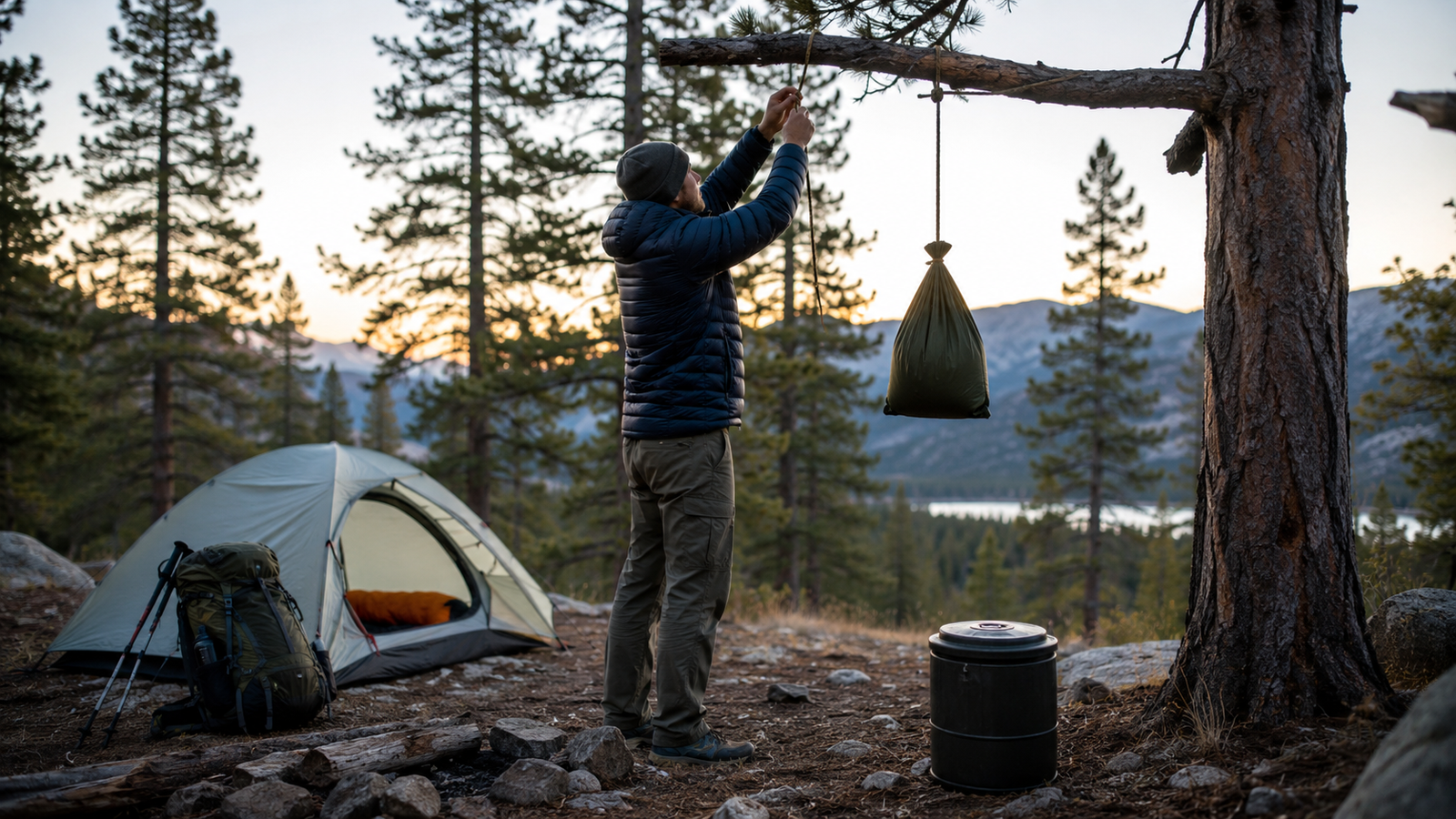
A bear bag is a food-storage system backpackers use to keep food, trash, and scented items out of reach of bears and other wildlife, typically by hanging it from a tree branch away from the trunk and the ground. It’s a lightweight, low-cost option compared to a hard-sided canister, but it isn’t allowed or effective everywhere. Some parks, forests, and wilderness areas require an approved bear-resistant container instead of any hang. Before choosing a bear bag over a canister, check the current food-storage regulations for your exact destination.
What Is a Bear Bag?
A bear bag is a durable stuff sack, typically made of tough, sometimes water-resistant fabric, that holds a backpacker’s food, trash, and scented items and is suspended from a tree branch using rope or cord, a carabiner, and often a small stick or toggle. The goal is to put enough distance between the bag and the ground, the trunk, and the branch itself that a bear can’t reach it by climbing, jumping, or leaning.
Don’t confuse a simple hanging food sack with a certified bear-resistant container. A regular dry bag or stuff sack offers no physical resistance to a bear that reaches it; its effectiveness depends entirely on being hung correctly and out of reach. A bear-resistant canister or approved soft-sided bag, by contrast, is built and independently tested to resist a bear’s teeth and claws even if the animal gets hold of it. In areas with smart, food-conditioned bears, or where regulations mandate a specific product, a hanging bag, no matter how well hung, is not treated as equivalent to an approved container.
Are Bear Bags Allowed Everywhere?
No. Food-storage requirements vary by park, forest, wilderness area, state, and even by specific trail section, and some destinations prohibit hanging food entirely in favor of approved bear-resistant containers or provided lockers.
Regulations exist because local bear behavior, food-conditioning history, and terrain differ widely. In places where bears have learned to associate people with easy meals, land managers often require hard-sided canisters because experienced bears can defeat even a well-executed hang. Yosemite National Park is a clear example: hanging food is prohibited throughout the park, and backpackers must use an approved bear-resistant container or, where available, a food locker. Other areas, including much of the Sierra Nevada backcountry along the Pacific Crest Trail and John Muir Trail, designate specific canister-required zones based on bear activity. In contrast, other sections of the same trails still permit a proper hang.
| Situation | What the Hiker Should Do |
|---|---|
| Bear canister required | Use an approved canister for that specific park or forest |
| Food locker required or provided | Follow the posted rules for that locker or bear box |
| Bear hanging is permitted | Follow that area’s exact hanging guidance and distances |
| No suitable trees available | Use an approved alternative container where permitted |
| Regulations are unclear | Verify official land-manager guidance before the trip |
Because this varies so much by destination, check the specific park or forest website or call the local ranger district before you decide whether to pack rope and a stuff sack or a canister.
What Should Go Inside a Bear Bag?
Anything with a scent that could attract wildlife needs to go in your storage system, not just your meals.
Food and Snacks
This includes full meals, trail snacks, energy bars, and any open or packaged food, whether you plan to eat it that day or not.
Garbage and Food Waste
Wrappers, leftovers, food scraps, and used packaging still carry food odor and need the same storage as unopened food.
Toiletries and Scented Items
Toothpaste, deodorant, sunscreen, lip balm, and other scented personal-care products should also be stored securely, since bears and other wildlife can be drawn to non-food smells just as easily as food.
| Usually Stored Securely | Why |
|---|---|
| Food | Strong wildlife attractant |
| Food waste | Retains food odor even when “empty” |
| Trash | Can contain food residue |
| Toothpaste and toiletries | Often contain appealing scents |
| Scented personal-care items | Can attract curious wildlife |
Requirements for exactly what must be stored can vary slightly by destination, so check posted signage or official guidance at your specific trailhead or campground.
How to Hang a Bear Bag Step by Step
Step 1 — Check Local Food-Storage Regulations
Before you pack rope or pick a tree, confirm whether hanging is even permitted at your destination, whether a canister or locker is mandatory, and whether the area has specific height or distance guidance. This should always be your first step, not an afterthought at camp.
Step 2 — Gather Your Bear-Hang Equipment
A typical setup includes a durable food bag, 40–60 feet of rope or cord, a small carabiner, and a small stuff sack or “rock sack” to weight your throw line. Not every item is mandatory for every method, but having the right gear makes the process faster and more reliable, especially in the dark.
Step 3 — Find a Suitable Tree and Branch
Look for a live branch that’s sturdy near the trunk but thin enough farther out that a bear can’t climb or walk along it, often about wrist-thick where the rope will hang. The branch should extend several feet horizontally from the trunk and sit high enough off the ground to give real clearance. Finding a genuinely suitable branch can take longer than beginners expect, so start scouting well before dark.
Step 4 — Position the Cord
Tie a rock or small weighted sack to one end of your line and throw it over the target branch, aiming to land it a few feet out from the trunk rather than directly against it. This usually takes a few tries; give yourself room and patience instead of forcing an awkward throw.
Step 5 — Attach and Raise the Food Bag
Once your line is over the branch, attach your food bag securely to the rope or carabiner and hoist it up slowly and evenly, keeping control of the line the whole time to avoid a spill or a snagged bag partway up.
Step 6 — Position the Bag According to Local Rules
This is where specific measurements come in, and it’s important not to treat one number as a nationwide standard. Many backcountry guides commonly reference hanging the bag roughly 10–12 feet off the ground and at least 4–6 feet out from the trunk as a general rule of thumb for a proper hang, but this is not an official regulation everywhere; some land managers publish their own specific guidance, and others prohibit hanging altogether. Always defer to your destination’s official rules over any general rule of thumb.
Step 7 — Retrieve the Bag Safely
In the morning, lower the bag carefully while keeping the line under control, avoid unnecessary wear on the tree bark, and pack up all of your cord and equipment. Leave no trace of your setup behind.
Bear Bag Hanging Methods Explained
Basic Bear Hang
The simplest approach ties the loaded bag to a rope thrown over a branch and secures the excess line around the trunk. It requires minimal gear, but the tied-off line at the trunk gives a persistent or food-conditioned bear a point to chew through, which is why many experienced backpackers prefer methods that avoid a trunk tie-off entirely.
PCT Bear Hang
The PCT method, named for its popularity on the Pacific Crest Trail, uses a single line, a carabiner, and a stick or toggle instead of tying the rope off at the trunk. After throwing the line over a branch, hikers thread the standing end through a carabiner clipped to the food bag, hoist the bag to the branch, then jam a small stick or toggle against the carabiner to hold it in place, releasing the rest of the rope so no line remains accessible at ground level. This removes the trunk-tie weak point of a basic hang and is widely regarded among long-distance hikers as a more reliable single-branch method. However, the PCT hang is not legal or sufficient everywhere along the Pacific Crest Trail; long stretches of the Sierra Nevada section require an approved hard-sided canister, regardless of hanging skill. Hikers planning a longer thru-hike should review our Pacific Crest Trail guide for section-specific food-storage requirements before they go.
Counterbalance Bear Hang
The counterbalance method splits food into two bags of similar weight, hoists one to the top of a branch, then ties the second high enough on the same line that a hiker can push it up with a stick until the two roughly balance out of reach. It avoids leaving excess rope at ground level, but it requires a taller, sturdier branch and more practice to execute well, and many backpackers find it fiddlier under pressure or in the dark than a single-line PCT hang.
Food Lockers and Bear Cables
Many developed campgrounds and some backcountry sites provide metal bear boxes, lockers, or overhead cable systems specifically so hikers don’t need to perform a tree hang at all. Where these are provided, using them correctly is almost always required, not optional, and they typically remove the guesswork of finding a suitable branch entirely.
Common Bear Bag Mistakes
- Failing to check local regulations is the single most common and most consequential mistake, since a technically perfect hang can still be against the rules.
- Assuming bear bags are permitted everywhere; some parks, like Yosemite, ban hanging outright.
- Hanging the bag too low, within easy reach of a bear standing on its hind legs.
- Positioning it too close to the trunk, where a bear can lean or climb out to reach it.
- Using an unsuitable branch that’s too thick (allowing a bear to walk out on it) or too thin (risking a break).
- Forgetting toiletries or scented items, leaving attractants outside the storage system.
- Leaving food unattended before it’s stored, even briefly while setting up camp.
- Waiting until dark to set up the hang, making it harder to find a good branch and execute the method cleanly.
- Assuming an odor-resistant bag can replace an approved canister when one is legally required.
- Using a regular stuff sack where an approved bear-resistant container is mandated.
- Leaving trash or food scraps outside the storage system, treating them as less important than meals.
- Assuming every park uses the same measurements or methods as the last place you camped.
Bear Bag vs Bear Canister vs Bear-Resistant Bag
| Storage Method | Weight / Packability | Setup Difficulty | Requires Trees? | Main Advantage | Main Limitation | Regulation Considerations |
|---|---|---|---|---|---|---|
| Hanging bear bag | Very light, packs small | Moderate; takes practice to do well | Yes, a suitable branch | Lightweight, low cost | Not physically bear-resistant on its own; execution-dependent | Prohibited or insufficient in many high-bear-density areas |
| Hard-sided bear canister | Heaviest, bulky, awkward to pack | Low; just close and store | No | Independently tested bear resistance; no tree needed | Adds significant weight and pack volume | Often mandatory in specific parks and wilderness zones |
| Approved soft-sided bear-resistant bag | Lighter than a hard canister | Low to moderate | No | Lighter than a hard canister; no tree needed | Not accepted everywhere hard canisters are required | Approval status varies by land manager; verify before relying on one |
| Food locker/bear box | None to carry | Very low, where provided | No | No gear or skill needed | Not available at most backcountry sites | Usage rules still apply where provided |
There’s no universal winner here. The right choice depends on the destination’s regulations, whether suitable trees exist, trip length, expected wildlife pressure, and your own experience executing a hang correctly.
When Should You Use a Bear Canister Instead?
A bear canister is often the better or the only legal choice when a hang isn’t practical or permitted. Reach for a canister when:
- A canister is legally required at your destination, as in Yosemite’s backcountry
- The land manager explicitly prohibits tree hanging
- Suitable trees or branches aren’t available, such as above treeline
- The area has strict, well-documented bear-storage requirements due to habituated wildlife
- You’re not confident you can execute a compliant hang, especially in the dark or bad weather
- A land manager specifies an approved bear-resistant product rather than any hanging method
Safety and legal compliance always come first; a canister isn’t just a backup plan, it’s frequently the required plan in high-use bear country.
How to Choose the Right Bear-Food Storage Method
Work through these questions before you pack:
1. What do local regulations require? This overrides every other consideration on this list.
2. Are suitable trees available? If not, a hanging system may be impractical regardless of what’s technically allowed.
3. Is an approved bear-resistant container required? If so, use the required type, not just any container that seems sturdy.
4. What length of trip are you taking? Longer trips need more food-storage capacity, which can favor a canister over a smaller bag.
5. How experienced are you with hanging food? A complicated method executed poorly can be less effective than a simpler, approved alternative.
Bear-Country Food Storage Checklist
- Check destination regulations before you leave home
- Confirm whether a bear canister is required for your route
- Identify any food-storage facilities at your campsite in advance
- Store all food properly, every night, without exception
- Secure trash and food scraps along with unopened food
- Secure toiletries and other scented items
- Set up your storage system before dark
- Keep your storage equipment accessible, not buried in your pack
- Never assume another park’s rules apply to your current destination
- Pack out all trash
- Follow Leave No Trace principles throughout
- Recheck official rules one more time before departure
Frequently Asked Questions
What is the purpose of a bear bag?
A bear bag reduces a bear’s or other animal’s access to food and scented items by suspending them out of reach, typically from a tree branch, in areas where hanging food is a permitted storage method.
How high should a bear bag be hung?
There’s no single nationwide measurement that applies everywhere. Many general guides suggest roughly 10–12 feet off the ground, but requirements and recommendations differ by destination, so always follow the specific park, forest, or wilderness regulations for where you’re camping.
Are bear bags allowed in every national park?
No. Food-storage policies vary significantly, and some parks, including Yosemite, prohibit hanging food entirely and require an approved bear-resistant container or food locker instead.
What should go inside a bear bag?
Food, food waste, trash, and scented toiletries like toothpaste, deodorant, and sunscreen should all go into your storage system, since each can attract wildlife. Always verify what your specific destination requires you to store.
Is a bear canister better than a bear bag?
It depends on the situation. Canisters offer tested, guaranteed resistance and no dependence on tree availability, but they’re heavier and bulkier. Bags are lighter and cheaper but depend entirely on correct execution and are prohibited in some high-bear-density areas.
What is a PCT bear hang?
The PCT bear hang is a single-line hanging method that uses a carabiner and a toggle to suspend food from a branch without tying off rope at the trunk, reducing one common failure point. Hikers must still follow the specific food-storage rules of whatever land-management area they’re passing through, since parts of the PCT itself require canisters instead.
Do toothpaste and toiletries need bear-safe storage?
Generally yes, since scented personal-care items can attract wildlife just like food. Check your destination’s specific guidance, since some areas define “attractants” slightly differently.
Can you keep food in your tent in bear country?
No. Storing food, trash, or scented items in your tent is unsafe and is prohibited in most bear country, since it can draw wildlife directly toward where you’re sleeping. Always use your destination’s required storage method instead.
Conclusion
A correctly executed bear bag hang can be a lightweight, effective food-storage option where it’s permitted. Still, it isn’t a universal solution, and it isn’t automatically bear-resistant just because it’s off the ground. Always check the current regulations for your exact destination first, choose the storage method that’s actually required or recommended there, and pack the right equipment for that choice. When trees aren’t available, regulations require a canister, or you’re not confident in your hanging skills, a bear-resistant container is often the safer and simpler call. Before your next trip, check our camping essentials checklist to make sure the rest of your gear list is as dialed in as your food storage plan.